Best practice: hybrid working at BDO
 Written by admin
Best practice: hybrid working at BDO
“The what determines the where. When you come to the office, you want to be sure you have a spot that suits what you’re there to do.”
BDO, an advisory and accounting firm with 2,700 employees in the Netherlands, has a refreshing vision on hybrid working. That vision already existed before the start of the COVID pandemic, but the pandemic certainly accelerated it. We interviewed Mike van Buul, facilities advisor and ‘impact manager’ at BDO, about this vision and — above all — how it came about and how it is being implemented now that hybrid working has become the new normal.

The start of a search
“In March 2020 we were in a phase where we were still very much searching. What do we actually want with our workplace concept? For several offices we were already looking for new locations — less along motorways, and more in city centres. Closer to public transport and social life.
BDO Worklife, BDO’s hybrid working project, is part of the broader project Sustainable Collaboration. Everything related to the new way of working comes together there. And that is a lot. Including office design, but also, for example, our mobility policy and coaching managers on leading and connecting with a (partly) remote team.
COVID accelerated our search for the ideal workplace concept. As with many organisations, it turned out that working from home works perfectly well for BDO in most cases too. Remote working was already happening in some departments and locations before, but others were still somewhat hesitant. We can say that hurdle has now been cleared.
The question of how you manage, coach, train and — above all — connect people in a hybrid working environment remains highly relevant. The role of the office is crucial in that.”
The ideal office feels like a party
“Hybrid working is the new normal for BDO. Where we used to think in percentages — 60% in the office, 40% at home — we’ve completely let that go. Hybrid working calls on everyone’s sense of responsibility.
The what determines the where. We call it activity-based hybrid working. Working location-independently based on what best fits your tasks, the collaboration with colleagues at that moment, and your personal situation and preference. At a BDO office, at a client’s location, or at home. You also get the freedom to organise your time more flexibly, naturally in consultation with your colleagues and clients.
The work itself should always be central. Sometimes that means you need to be able to concentrate; other times you need to be able to discuss things with your team.
The office building itself is increasingly becoming a primary employment benefit. It needs to be a great place to come to. That also attracts new talent.
Our goal is for all BDO offices to feel like a party to visit. A place where you feel at home, get inspired, and where you feel like a true “BDO person” again. The office as a meeting place where you genuinely connect with colleagues and can collaborate comfortably. You go there for the best coffee and sandwiches.
And from the office you can easily walk into a vibrant city centre, giving you a great experience during lunch or after work too. Handy for after-work drinks with your team! The office is then not only inviting during working hours, but also before and after.
Hybrid working calls on everyone’s sense of responsibility.
The impact of COVID on office design
COVID has influenced how the new offices have been designed. The flex ratio has been adjusted. There are fewer individual workstations and more space for gathering, brainstorming and chance encounters. The office as a clubhouse with informal ‘living rooms’ with poufs here and there, meeting rooms where hybrid consultation is possible, and train-compartment-style booths for more informal discussions.
At every location you will always find something that reflects the connection to the region. For example, in the new office in The Hague, a real greenhouse has been placed that serves as a meeting room, referencing the bulb-growing region nearby.”
How do you prevent empty offices?
When you come to the office, you don’t reserve a fixed spot, but a place at the inn.
“During the pandemic, all colleagues were asked regularly how they saw the future of work. More at home or more at the office? And what should the office look like? That data was incorporated into the steering, advisory and various project groups.
The architect then designed a ‘meandering’ landscape with different zones on each floor: meeting, landing and connecting, and collaboration. For collaboration we make a further distinction between focused collaboration in a closed room or at collaboration spots in an open space. Every floor has a social heart and each location has one eat/work café.
Both meeting rooms and collaboration spots can be reserved in advance via an app. That way you know for sure you have a spot when you come to the office.
Also new for BDO is that there are no longer fixed ‘zones’ — departments or teams no longer have a dedicated space on a particular floor. Instead, there are anchor points. Essentially just lockable cabinets. When you come to the office, you don’t reserve a fixed desk, but a spot at the inn. Once at the office you’re free to sit wherever you like, but the chance of running into someone from your department or team is greatest near one of these anchor points.
So far, colleagues who have already moved or had a sneak preview of the new locations are very enthusiastic.”
How does a workspace reservation app fit into this picture?
“BDO uses the Why at Work app to reserve a spot in the office. We have a concept we believe in. That concept calls for an app that supports colleagues in coming to the office and ensures everyone is guaranteed a spot suited to the activities of that day — one that helps find other colleagues and supports collaboration at the office. Booking is then a means, not an end. You book because you want to, not because you have to.
At the start of the COVID period, in early March 2020, we hastily set up a workspace reservation system with the sole purpose of managing occupancy. We hadn’t expected such a reservation tool to become a permanent part of our way of working. When it became clear that our way of working would change permanently, we were initially still very much searching for our workplace concept.
As that became clearer, it quickly became apparent that the existing system didn’t fit. So we went looking for a different app — and that turned out to be Why at Work.”
No fixed desks to reserve
We sometimes compare the new ‘going to the office’ to attending a football match.
“Although we understand that the reason for going to the office is different for everyone, we sometimes compare the new ‘going to the office’ to attending a football match. 1: You want a good spot. What’s good is different for everyone, but the best experience comes with the right people around you. 2: You want a guaranteed spot and don’t want any unpleasant surprises.
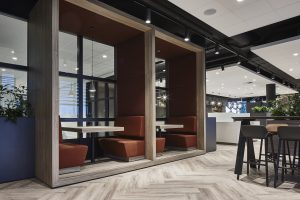
Once you’re in the clubhouse (office), you’re there to watch the match, but also for the social atmosphere. You want to sit somewhere that feels right in that moment, where you can work best for your task of the day. You don’t always have to sit in a fixed spot. Quite the opposite. That’s also how chance encounters happen — and those are usually great and valuable. We encourage this through both the office design and the way you can reserve a workspace.”
Steering behaviour with data
“We deliberately choose not to allow booking of a specific desk. In principle, everything can be locked down with technology, but does that actually make it more enjoyable? Does it make coming to the office feel like a party? We don’t think so, so we trust in behaviour. Sometimes there will be behaviour that doesn’t match our vision — for example, when employees book in the same (usually focus) zone every single day.
A kind of ‘towel on the sunlounger’ in a single-person room. Of course you’re welcome to come to the office to work in a focused manner, but should that really be five days a week? And does it have to be in a single-person room every day?
We deliberately choose not to allow booking of a specific desk.
If you have a good reporting tool, that kind of behaviour will stand out at some point and we can start a conversation with a colleague. What’s driving this? Do you always need to work in a focused setting, or can we facilitate you differently so other colleagues can use that space too?
The insights we get from the data in the Why at Work platform help us recognise patterns — both to adapt our future layout to actual usage, and to help steer behaviour.
Desk booking app: a crucial part of hybrid working
“I believe you simply want to book a workspace to be sure you have a spot that fits the work activities of your day. Booking is a no-brainer.
You use the app for everything you need for your day at the office: lunch, parking, meeting rooms, pool car.
Booking is a no-brainer.
The use of Why at Work is therefore also crucial after COVID to make our hybrid working vision succeed. Right now we still use the app to monitor maximum occupancy, but hopefully that won’t be necessary much longer. Then it becomes even more about how you facilitate the employee when they want to come to the office.”
Why at Work puts the employee first
“We spoke with many parties. Most of those apps put the data first. Their starting point is the workspaces and how to use them as efficiently as possible. Why at Work was developed from the philosophy of facilitating the employee as much as possible in coming to the office. And that aligns seamlessly with our vision.
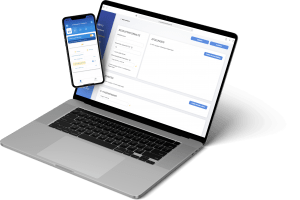
The app and the admin portal are very user-friendly. With just two actions you can easily reserve your workspace. Super intuitive. That’s why colleagues experience using the app as something positive.”
A great collaboration with Why at Work
“When we first got to know Why at Work, our vision wasn’t fully crystallised yet. Our conversations with Why at Work gave us new insights — it felt like we were inspiring each other.
One of the reasons we then chose Why at Work was the flexibility and the possibility of developing the platform together. We really matter as a customer. Every Monday we discuss our wishes. We regularly have new insights and discuss them with the Why at Work team. That’s how we make the app genuinely better together.”
Tips for organisations getting started with hybrid working
“The road to hybrid working is a great journey of discovery. We’ve taken the first steps, but practice will tell us how our vision ultimately plays out. In our journey so far, we’ve regularly bumped our heads, course-corrected and kept going. We’ll continue to do that with each new office we open.
Start with a clear vision of your own
What we’ve learned, and what I’d like to share with other facilities managers: really start with your own vision first. How do you want your office to be used, what behaviour do you want to encourage, what should the building convey?
Then look for a workspace reservation app that broadly fits that vision. And a supplier that’s willing to move with you. That way you truly strengthen each other.”

